Author
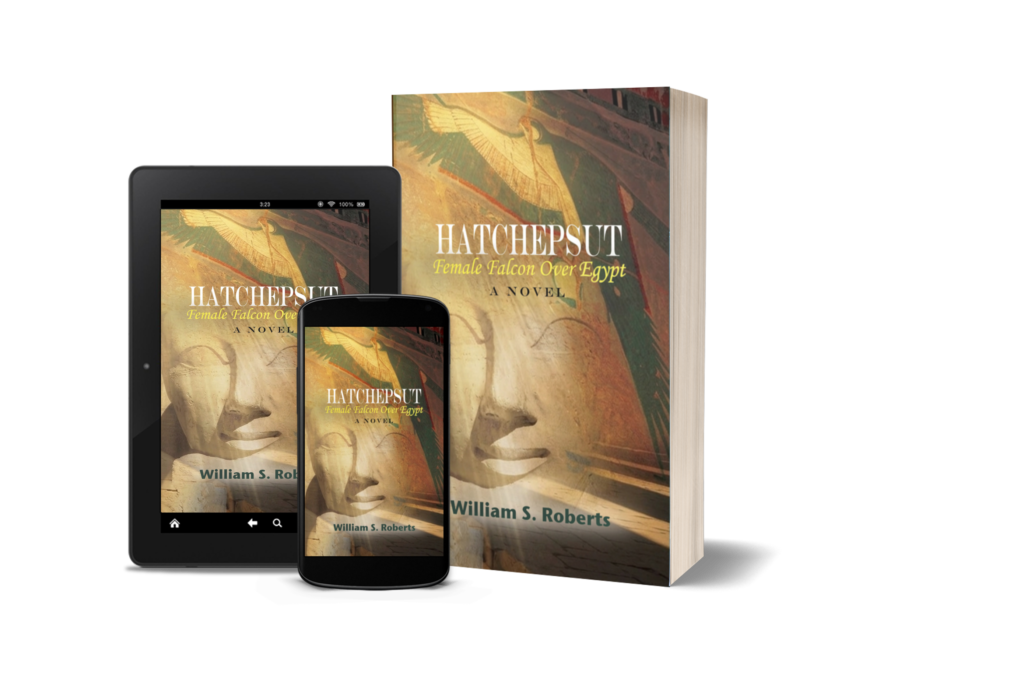
A sweeping historical novel that brings ancient Egypt's most remarkable female pharaoh to vivid, unforgettable life.
William S. Roberts blends meticulous historical research with masterful storytelling, transporting readers to the golden age of the 18th Dynasty.
Meet William S. Roberts
William S. Roberts, a native of Riverside, California, served 20 years in the U.S. Navy as a Surface Line Officer, specializing in engineering and anti‑submarine warfare. His deployments included Vietnam, the Mediterranean during regional conflicts, and a year at Pan Mun Jom, Korea. While in service, he earned a Master of Science from USC and a Juris Doctor from the University of San Diego. After retiring in 1989, he practiced civil litigation for two decades, focusing on product liability defense. A lifelong student of history and lecturer, he now resides in Garden Valley, Idaho with his wife Marianna.
Hatchepsut
Female Falcon Over Egypt
Hatchepsut ruled during the early 18th Dynasty, approximately 1507 to 1458 BC. That makes her reign one of the longest and most prosperous in Egyptian history. She built the magnificent mortuary temple at Deir el-Bahri. She sent a famous expedition to the land of Punt, returning with myrrh trees, ebony, and exotic animals. She raised obelisks at Karnak that still stand today. She called herself King, wore the double crown, the false beard, and the bull’s tail, and appears in inscriptions with male pronouns.
She Ruled When Women
Didn't Rule.
Three and a half thousand years ago, a princess watched foreign kings grovel at her father’s feet. She didn’t just want to be queen. She wanted to be Pharaoh.
Hatchepsut
Female Falcon Over Egypt
Hatchepsut ruled during the early 18th Dynasty, approximately 1507 to 1458 BC. That makes her reign one of the longest and most prosperous in Egyptian history. She built the magnificent mortuary temple at Deir el-Bahri. She sent a famous expedition to the land of Punt, returning with myrrh trees, ebony, and exotic animals. She raised obelisks at Karnak that still stand today. She called herself King, wore the double crown, the false beard, and the bull’s tail, and appears in inscriptions with male pronouns.
She Ruled When Women
Didn't Rule.
Three and a half thousand years ago, a princess watched foreign kings grovel at her father’s feet. She didn’t just want to be queen. She wanted to be Pharaoh.
A historical fiction novel rooted in real archaeology, real politics, and one of the most remarkable leaders the ancient world ever produced.
Rooted in Real History
Every named character in this novel actually lived. Every jewel described can still be viewed today at the Egyptian Museum in Cairo or the Metropolitan Museum of Art in New York. Roberts doesn’t invent the ancient world – he reconstructs it, carefully and affectionately.
A Fully Human Portrait
Hatchepsut is not a symbol. She’s a daughter, a wife, a strategist, a woman who drives a chariot at full gallop and screams with joy. Roberts gives her the inner life history often denies its most powerful figures. You won’t just admire her. You’ll understand her.
A Story for Our Time
What does it take for a woman to lead when the world insists she shouldn’t? How does ambition coexist with love? How do you hold power without losing yourself? These questions are 3,500 years old and still completely alive today
Female Power and Defying Gender Norms
Hatshepset’s journey from princess to de facto ruler challenges ancient Egypt’s patriarchal traditions. The story explores her intelligence, political skill, and determination to wield power traditionally reserved for men while navigating expectations of motherhood and queenship.
Hatchepsut
Female Falcon Over Egypt
She was born a princess in a world that had no word for a female pharaoh. She grew up watching foreign kings kneel in her father’s throne room, learning the art of power before she was old enough to wear a wig. She married a half-brother who was everything she wasn’t: passive, uninterested, incurious. And when he died, she didn’t step aside.
She stepped up.
William S. Roberts spent years living with this woman across 3,500 years of history to write Hatchepsut: Female Falcon Over Egypt. Drawing on real archaeology, real people, and real political intrigue from ancient Egypt’s glorious 18th Dynasty, he builds a portrait of a leader who shouldn’t have existed – and who changed everything.
“The ancient Egyptians believed that to say the name of the dead was to make them live again. The names Hatchepsut and Maatkare appear 1,145 and 25 times, respectively, in this book. Feel free to say her names aloud as you read them.” – William S. Roberts, Author’s Note
About William S. Roberts
William S. Roberts is a student of history in the truest sense – not someone who reads about the past, but someone who tries to live it long enough to write it honestly. He’s spent years studying the people and culture of ancient Egypt’s 18th Dynasty, consulting with leading Egyptologists, and asking the kinds of questions that don’t have tidy answers.
Hatchepsut: Female Falcon Over Egypt is his effort to give one of history’s most remarkable leaders the full-dimensional life she deserves.